
Landmines
Emotional Landmines
.
Have you ever watched an ordinary conversation turn into a hostage negotiation? One wrong word and suddenly you’re negotiating with someone who’s gone completely nuclear.
Welcome to the emotional minefield, where the explosives are invisible, the tripwires are everywhere, and nobody gave you a map.
I’ve witnessed my share of emotional meltdowns, but one afternoon at a bar could have used a referee.
A friend and I hadn’t seen each other in a while and had planned a weekend together, just the two of us. She wanted to stop at a bar to see her boyfriend first. That wasn’t how I’d envisioned our weekend beginning, but I went along.
Making a beeline for the bar, my friend ordered a drink. Moments later, she and her boyfriend were verbally at each other’s throats.
Just minutes earlier, she’d been happy and excited about our weekend. But the instant their emotional minefields collided, all hell broke loose. They went at each other with such hostility that I stood there stunned, smack in the middle of the blast zone.
I had no intention of losing a limb in somebody else’s war, so I escaped to the bathroom. When I returned, they were still at it.
You’ve seen it at family dinners, where two siblings can resurrect twenty years of grievances before the first bite. Or at work, where a three-word exchange can turn an ordinary staff meeting into a full-blown feud.
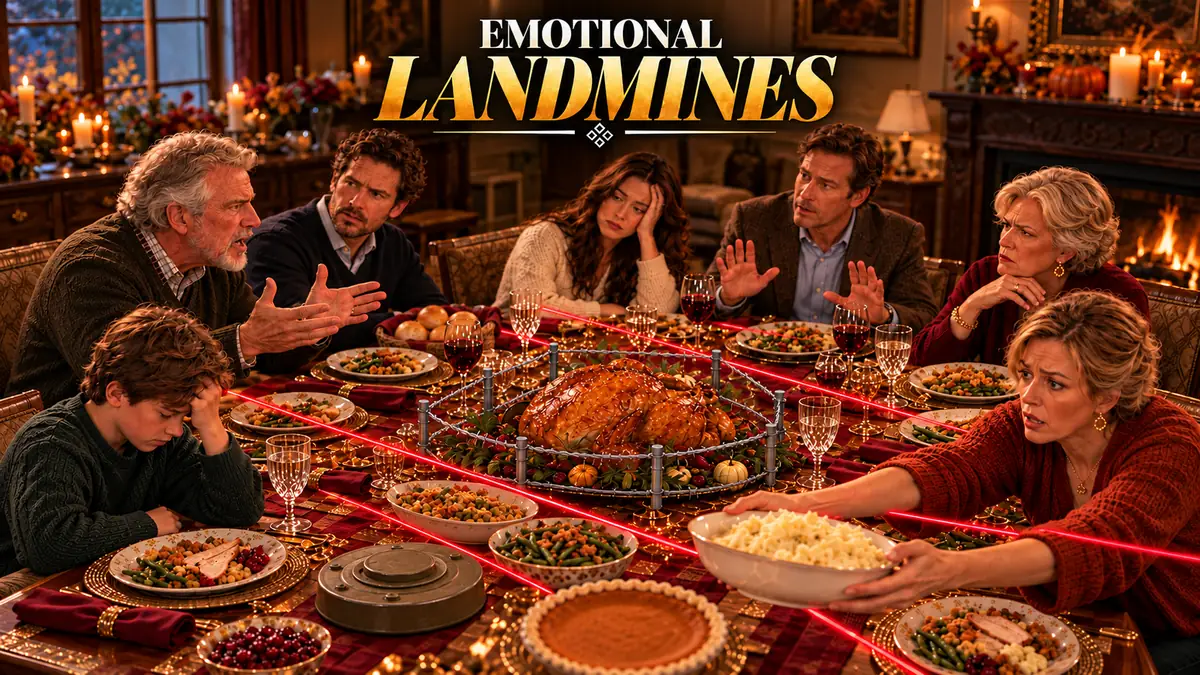
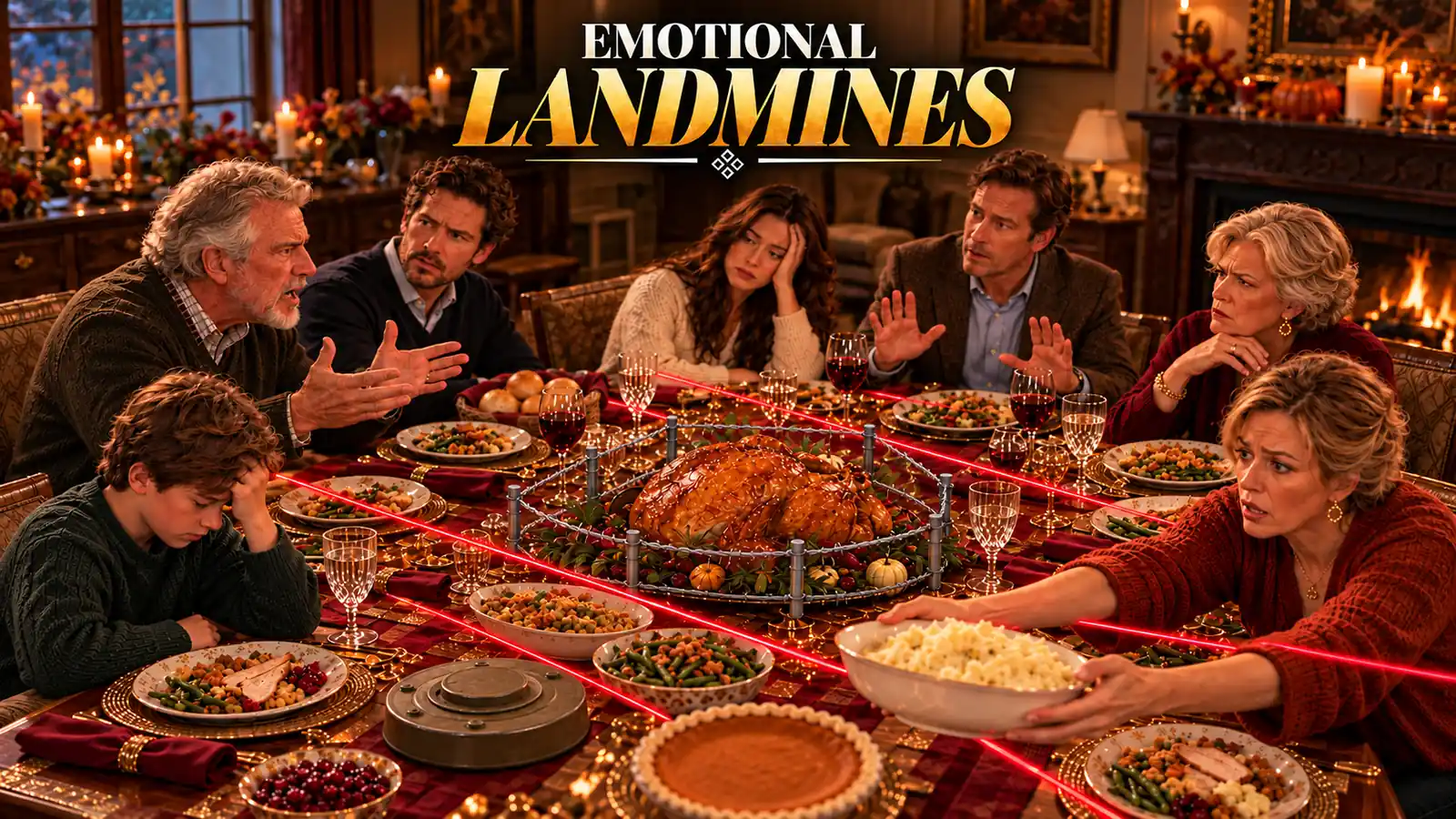
Ever watched one of those heist movies where a thief contorts himself through a maze of laser beams, knowing one wrong move will set off every alarm in the building?
Now imagine needing those gymnastics to survive Thanksgiving dinner.
Mention politics and Uncle Bob goes ballistic. Two siblings require opposite ends of the table, and heaven forbid anyone criticizes the turkey.
You’re performing Mission: Impossible maneuvers just to pass the mashed potatoes.
The person everyone tiptoes around may have no idea how carefully others choose their words to avoid a confrontation. To them, their reactions are simply part of who they are.
“I’m passionate.” “I have a temper.” “I’m a mama bear.” “That’s just how I am.”
Over time, repeated behavior becomes an unquestioned personality trait, and the personality trait becomes an excuse to avoid examining it.
You’ve become an emotional bomb disposal technician without training, protective equipment, or hazard pay.
Being considerate of someone’s feelings is one thing. Having to constantly edit yourself to keep them from exploding is another. At what point does consideration become self-censorship?
Think about the energy you’ve spent anticipating someone’s next outburst, rehearsing conversations, or swallowing words to keep the peace.
After enough encounters with people who’d rather go down swinging than question their own version of reality, I’ve learned when to stop wasting my breath. The Borg had a phrase for it in Star Trek: “Resistance is futile.”
You know the argument so well you could recite both sides before it even starts. At some point, you wonder whether you’ve wandered onto the set of Groundhog Day.
Some people become so accustomed to their reactions that they mistake them for facts. A disagreement becomes disrespect, a question becomes criticism, and an observation becomes a personal attack. By the time you’ve figured out what offended them, they’re already preparing their defense.
You hold up a mirror. They draw a machete.
People can get downright ferocious defending the very things that keep them trapped.
They’ve built a fortress to protect themselves, only to end up both prisoner and prison guard.
The conversation is new. The argument is ancient. Before you know it, you’re fighting with decades of someone else’s history.
By now, you’ve probably got someone in mind. You’ve been recognizing their antics, remembering the arguments, perhaps even congratulating yourself on your superior minefield-detection skills.
Wonderful.
Now turn the mirror around.
What if you’re somebody else’s emotional minefield?
People may be rehearsing conversations before approaching you, withholding their opinions because disagreeing is exhausting. Meanwhile, you’re taking their silence as agreement.
Now we’re getting somewhere.
Triggers are treasures.
Every emotional flare-up offers a clue about what’s lurking beneath the surface. The question is whether you’re willing to investigate or would rather keep blaming whoever struck the match.
Getting triggered isn’t the problem. It’s what you do next.
You can blame the person who set you off, defend your reaction, and add another incident to your growing collection of grievances. Or you can get curious about why those particular words got under your skin in the first place.
The trigger is pointing at something. Are you willing to look?
The trigger isn’t the treasure. What you discover beneath it is.
What exactly set me off, and why? What am I defending so fiercely?
And do I still want to?
Self-inquiry isn’t an invitation to beat yourself up. It’s an archaeological expedition into your own conditioning. You start digging and discover beliefs you didn’t know you had, including a few ancient relics that have been making decisions on your behalf for decades.
Now that’s a revelation worth excavating.
Awareness introduces something automatic reactions rarely allow: choice.
Emotional mastery isn’t about eliminating anger, fear, sadness, or disappointment. It’s recognizing those emotions without surrendering your decisions to them.
Emotional mastery is foundational to self-mastery. We can talk about sovereignty, conscious creation, and personal freedom all day long, but what good are those ideals if a single comment can commandeer our emotional state?
The Borg insisted resistance was futile. They might have had a point about changing someone else’s programming, but your own is fair game. Once you recognize the script, you can question it, rewrite it, or refuse to perform it altogether.
You’ve explained yourself, approached the conversation from every conceivable angle, and watched the same argument return for another encore.
Here’s the rub: recognizing someone else’s patterns doesn’t mean you can change them. And if they have no interest in examining themselves, good luck doing it for them.
You can lead a horse to water, but you can’t make it drink. And no matter how tempting it is to shove its face into the trough, that won’t work either.
We’ve spent all this time learning to navigate the minefield. But here’s a question: Why are we still buying tickets to visit it?
Family relationships can feel like permanent geographical assignments, as though sharing DNA means you’ve been sentenced to the same emotional zip code for life.
Since when did a shared history become a lifetime membership contract?
You can love someone without volunteering for unlimited exposure to their emotional explosions. Yet people spend years explaining, negotiating, and defending their right to step away.
Think about that. You’ve returned to the minefield to request authorization to leave.
And you’re asking the person who planted the explosives.
You don’t need a dramatic confrontation or a closing argument worthy of a courtroom. You can simply decide how much access someone has to your life.
Love doesn’t require becoming a permanent member of someone else’s bomb squad.
Remember those Thanksgiving gymnastics? You’ve spent years perfecting your technique, twisting and contorting to avoid setting off the alarms.
You could qualify for the emotional contortionist Olympics.
But here’s the revelation: You don’t have to participate.
Growing up around unpredictable tempers can turn a child into an expert at reading a room. A change in tone or the slightest shift in expression becomes valuable intelligence.
The trouble is, nobody tells the child when it’s safe to retire from the job.
The field is open.
Where will you choose to walk?
Read The Next One: THE DANGEROUS CHIP ON MY SHOULDER →
PLAY IN THE LIVING LAB →
ENJOY THE FULL LIBRARY:
The Dangerous Chip On My Shoulder
Why Do Smart People Stay Stuck?
I Threw Away Every Medal I Ever Earned
Instead Of A Promotion, I Got Fired
I Ran An Experiment With The Universe
People MisJudge High Performers
The Cost Of Other People’s Opinions Of You
Some books are discovered after they’re published.
This one can be experienced while it’s still unfolding.
What began with deep self-inquiry became the Courageous Heart Expedition—and now my first book. Stories, films, photographs, reflections and discoveries are coming together as the work continues to unfold. You’re invited to explore what I’m creating and find your way in.
My Latest…

The Living Lab
Life is a lab. It’s always open.
How much of your life did you actually choose?
Most of us inherit far more than we realize—beliefs, identities, fears, and subconscious programming that control how we see ourselves.
The Living Lab is an ongoing exploration of what we discover when we question what we’ve been taught, challenge the ego, examine our conditioning, and experiment with different ways of being.
Because once you see what you didn’t choose, you get to decide what comes next.
SUPPORT THE WORK
Independent work like this exists because people choose to help make it possible. You can help me keep creating it.